


If you, like me, have that big nerd energy, then you’ve probably spent a lot of time studying story structure. Which means you’re acquainted with the idea that characters have an external motivation and an internal motivation. You’re not friends with the concept, but you’ve seen it at parties. You’ve nodded at it other across the aisle of the grocery store, and then desperately prayed that it didn’t approach you to have a conversation.
External motivation is what a character wants, the thing they’re chasing.
Internal motivation is the thing they need to be the most Oprah version of themselves.
Most of the time, the character knows what they want from the very first page, but have no idea what they really need until much later. The arc is the process of them learning what they need as they pursue the thing (they think) they want. Plus, we get bonus points if the want and the need are in conflict with one another, because that causes natural tension, and tension makes the storytelling part of our brain make that cartoon ‘AWOOGAH’ sound.

But, I’ve always struggled to really make it work for me.
In their book, Scriptnotes, Craig Mazin and John August call bullshit on this view of character motivation. Their feeling is that the want vs need framework is a trap that’s not that helpful for planning a story. In Episode 611 of the Scriptnotes podcast, John and Craig offer a different way in: instead of starting with what a character wants or needs, start with what they’re doing.
They break it down into five base-level things that all creatures do in order to survive: the five Fs.
Flee: Run from danger.
Fight: Push against a threat.
Feed: Consume, hoard, accumulate.
Feel good: Chase comfort/relief.
[Another word that starts with an F, redacted because my mom reads this]: Pursue desire, connection, intimacy.
Here’s John on feeding:
“Feeding, like literally they could eat, but also, any time they’re trying to hoard or they’re trying to store up or save things, that’s all about feeding. It’s the fear of hunger down the road. Greed is essentially a feeding expression. It’s the desire to accumulate, to have those things. With control of the food, with control of the money, you have power, you have status. These are all tied up together.”
And John on fleeing:
“Obviously, we think about fleeing as it relates to a slasher movie, where you’re running from the killer. But realistically, our characters are often running from something, running from a danger that they may not even be able to say is the danger they’re running from. Characters are always running from something, some version of something that scares them, something about themselves, something about their situation.”
The power of framing motivation this way is that every one of the five Fs is an action, which gives the character something to do in a scene, which means it gives you plot. What sparked my brain was that those base-level motivations are also connected to something deeper in each character… and so perhaps give us a clever way to position the internal motivation (the need).
Listening to this episode, I kept thinking about the horror film Abigail (2024). It’s a vampire movie, and the two motivations driving the story map straight onto the five Fs. Abigail is literally consuming her victims (feeding), and her victims are fleeing from her through the house.
There’s such a clear link between those base motivations and their internal needs: Abigail hungers for the love and affection and attention of a parental figure, and each of her victims are at her mercy because they were avoiding something in their real life.
That’s about when I paused the podcast, and began doing my best Beautiful Mind impression:
If the external F (the base-level thing the character is doing) maps onto an internal need they can’t see or won’t name, then pursuing the base motivation becomes the character arc, because the external action becomes a distorted version of the internal need. Basically, the character thinks they’re solving the right problem with their action, but they’re not. And the internal need and external action are in conflict. Enter tension, stage left.
The question to ask your own characters
Which F are they doing? Not which F do they feel, which one are they doing, in scene after scene? That’s the base-level motivation generating your plot.
What’s the internal need that F is a distorted version of? The thing they actually need to become whole, but can’t see because the external action feels like it’s working.
The whole point is that the F and the need pull in the same direction. Abigail feeds on blood and hungers for parental love, her victims flee from a vampire and from their own unresolved lives. The character’s arc is them slowly realising that the external version was never going to satisfy the deeper one.
Setting this up in First Draft Pro
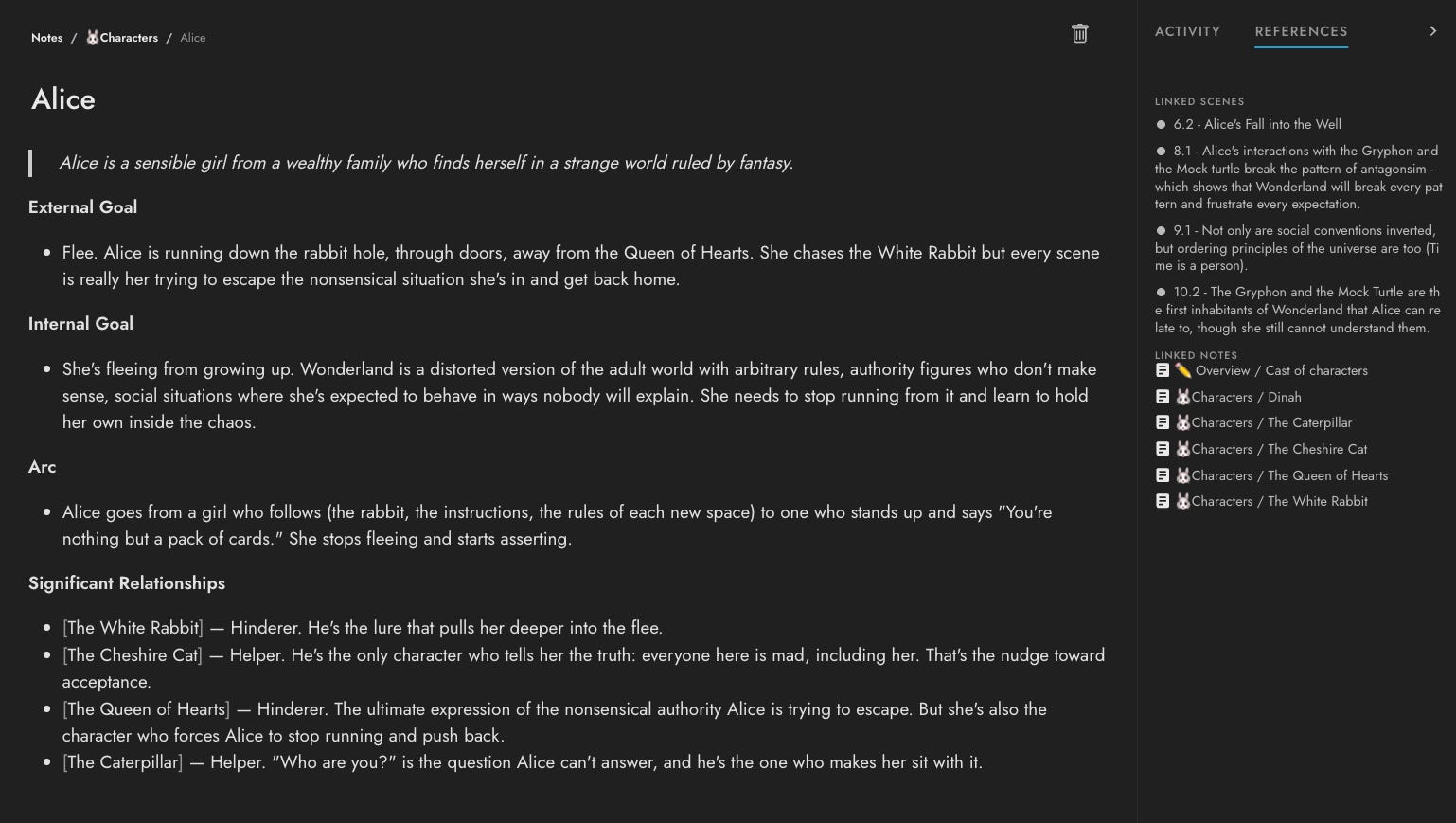
Because I’m working on my own novel in First Draft Pro, I keep character notes linked together in my notes folder. I have a note for each character, with the following information:
External Goal
What does the character do*?
Internal Goal
What does the character need to be emotionally whole (a distortion of what they currently do)?
Arc
How does the character grow over the course of the story?
Significant Relationships
Family, friends, foes (and I tag each one as a helper or hinderer, and then link to that character’s note so that I can navigate between them easily)
*I used to put in what does the character want, but I’m trying this new approach.
This is definitely worth a try, I like how you tied together the external action covering the internal conflict a character wrestles with.
Yessss this brings to mind Stanislavski's tasks! Psychologizing characters wants and needs can indeed stiffen the process and lead to a sort of overthinking of the actual drama we're supposed to see